Vancouver, Canada
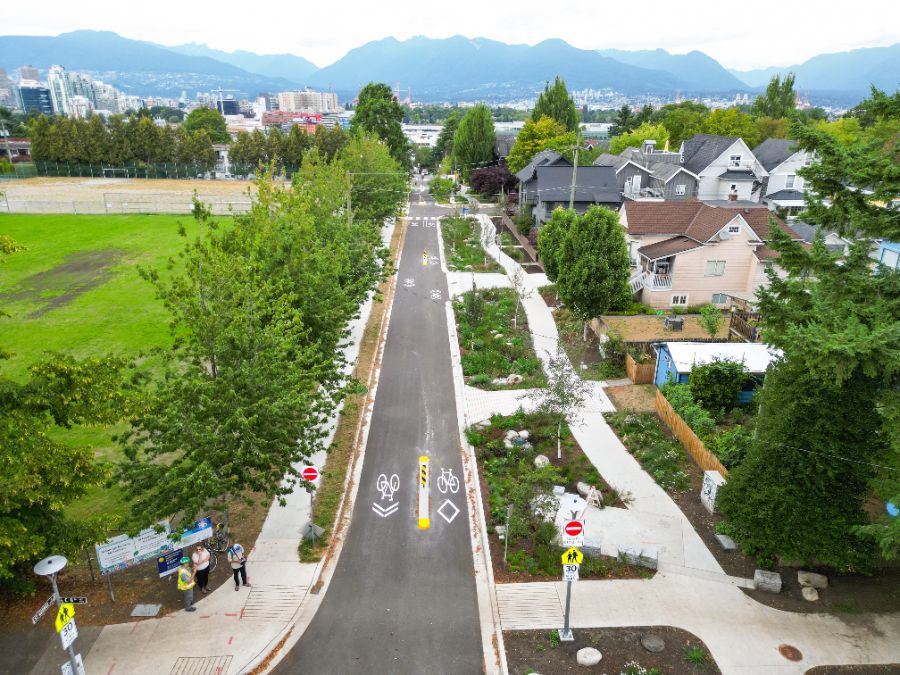
Blue Green Systems: St. George Rainway and the Path to a Citywide Network
The City of Vancouver is designing and implementing Blue Green Systems (BGS) to manage rainwater sustainably and resiliently in the face of climate change and urban densification. BGS have been conceived as a network of park-like streets and open spaces throughout the city that will manage rainwater and floodwater, promote active transportation, connect people to parks and nature, and provide habitat for wildlife and pollinators. The St. George Rainway is Vancouver’s most ambitious blue green corridor to date, transforming a residential street into a multi-block green rainwater infrastructure (GRI) and sustainable transportation corridor. Initiated by community volunteers and advanced by the City of Vancouver, the Rainway integrates stormwater management, urban ecology, active transportation, and public realm benefits. By capturing and treating rainwater at the surface through a series of rain gardens, the Rainway reduces pressure on the sewer system and improves downstream water quality.
Vancouver sits within a temperate rainforest, shaped by its relationship with the surrounding waters. Prior to urbanization, rainfall moved through watersheds where it was absorbed, slowed and conveyed through natural systems. Development severed the city from its natural watersheds, leaving it vulnerable to compounding urban pressures: combined sewer overflows (CSOs), aging infrastructure, extreme rainfall, and drought. Blue green systems address these challenges holistically. The City has an aging combined sewer system, which overflows to surrounding water bodies when it rains. Urban densification and climate change exacerbate this issue, adding additional flows and more extreme storms. Localized flooding is also an issue when drainage systems are overwhelmed. To address CSOs, the City has been separating the sewers since the 1970s. This approach, while effective, is costly and time-intensive. Vancouver adopted the Rain City Strategy, which was informed by federal, provincial, and regional legislation that directed the reduction of CSOs. St George Street faces these urban challenges and others, like ongoing biodiversity loss, uneven tree canopy coverage and a lack of green space. Without intervention, pipe upgrades would be needed in the near future to accommodate increased flows due to densification and climate change.
Blue Green Systems (BGS) are Vancouver's response to the challenges described above, a long-tern vision to restore the city’s relationship with its watersheds, designed to be implemented incrementally over time. The network largely follows Vancouver’s historic buried streams, which trace the city’s overland flow paths. While pipes manage minor drainage, streets serve as the major drainage pathway during large storm events, conveying overland flow that exceeds pipe capacity. As climate change intensifies rainfall, this role becomes increasingly critical.
BGS are designed to formalize and optimize this function – managing water on the surface, preserving sewer capacity, and deferring costly sewer upgrades. Alignments were developed through collaboration across various city departments to identify corridors that would expand and connect active transportation routes and simultaneously manage overland flow, restore ecological connectivity and enhance how people move through the city. The St. George Rainway is Vancouver’s first district scale implementation of a Blue Green System. It was identified through a land use planning and servicing strategy that recognized the need for sewer upgrades in a rapidly growing area. Rather than expanding pipe capacity, the St. George Rainway was conceived as an opportunity to manage water on the surface, deferring those upgrades through GRI.
The St. George Rainway is having a noticeable impact on local flooding and rainwater management, biodiversity, and the community. It is designed to treat approximately 17,500 m3 and infiltrate 5,000 m3 of rainwater annually, which accounts for 90% of Vancouver’s annual rain events with additional capacity for larger storms. This one way the Rainway strengthens resilience to climate-related hazards and natural disasters, per SDG Goal 13. Early performance observations during major storm events indicate the Rainway is performing beyond its design standard, effectively absorbing rainwater. The plants and soil in the Rainway then remove pollutants from the rainwater, improving water quality in downstream water bodies. Ongoing performance monitoring with water level loggers and visual inspections by staff is part of the City’s GRI Asset Management program. The plants in the Rainway were carefully chosen based on data from community science monitoring and insights from Indigenous ethnobotany work. The goal is a self-sustaining system that improves local biodiversity and integrates community values while reducing long-term maintenance.