Vienna, Austria
Word-Up – Youth Parliaments
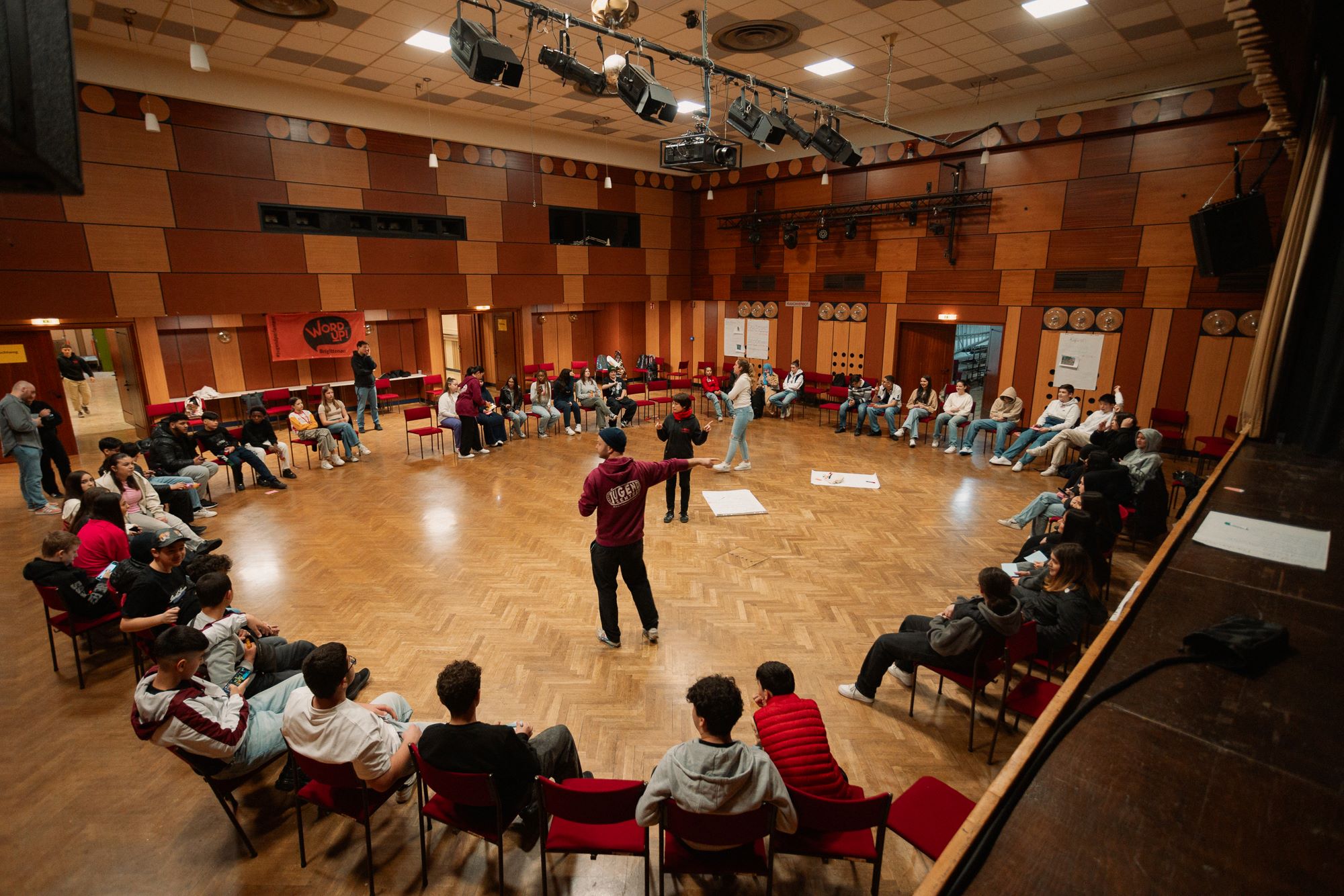
“WordUp” youth parliaments are an active youth participation initiative for 13- and 14-year-olds, run by the Association of Viennese Youth Centres. The program is a collaboration involving local district councils, youth work, and schools. The advantages of the “Word Up” model are that it includes one or two full age cohorts in a district, gives young people full control over the topics they want to tackle, and provides them with a significant budget (€30,000 to €100,000) to allocate. It starts with workshops in all participating schools in the district; this process involves several hundred children. They elect representatives who then work on their topics in local youth centres. Municipal experts and local politicians get involved; legal and financial matters are explained. Delegates decide how to use their budget. This includes issues relating to public areas (parks and playgrounds), traffic, culture, or local youth work. The “WordUp” model ensures broad and concrete participation with immediate outcomes.
The project started with the challenge of strengthening young people’s identification with their district and sense of responsibility for the areas where they live. Active participation was intended to support these goals. The appropriate level was identified as the local district (Vienna has 23). A district is the smallest municipal structure with its own district parliament and district mayor. Districts have between 40,000 and 150,000 inhabitants. The local district parliaments are responsible for financing a “local participatory structure for youth.” They contract local youth work institutions to establish these structures. By law, a district has certain political responsibilities, most importantly local urban development, local parks, playgrounds, streets, the sponsorship of cultural activities, and other matters. Districts receive a share of the Viennese municipal budget according to their size and population. The district parliaments decide annually on these budgets within the framework of Vienna’s state constitutional rules. Vienna is one of the nine states of the Federal Republic of Austria. The challenge was to involve as many young people below the voting age (16 in Vienna) as possible in an age-appropriate way that also gives them responsibility and provides an educational experience in politics and urban planning.
Since 2000, all districts have faced pressure to establish youth participation. Some politicians were unhappy with their “Advisory Board System,” which involved only a few young people. Local youth workers developed a way to involve more pupils. One district mayor was convinced it could work. Finally, a triangle of local schools, the local parliament, and youth work was established. All three fit within the Viennese municipality’s “district structure.” Other districts initially retained their “Advisory Boards.” WordUp eventually proved successful. It was refined in practice and reached its current structure by 2005.
Success Factors:
- Combining three players at the district level: local schools, local parliaments, and local youth work
- Focusing on ages 13–14, when pupils usually still attend school in their local district (this changes when they enter upper secondary school at ages 14–15)
- Young people in this age group spend their leisure time predominantly in their local district
- Local parliaments have the power to involve the relevant municipal departments in the project
- Public areas and playgrounds are crucial for children
- This connects young people’s needs with the relevant politicians.
In 2025 alone, around 3,000 students, six district mayors, and representatives from twelve different city departments participated in six different WordUp youth parliaments. They held 124 school workshops, 32 delegate workshops, and twelve plenary sessions. The evaluations (questionnaires for 250 youth delegates) demonstrate the program's far-reaching impact. Young people feel better informed about their district and how politics works. They appreciate that politicians listen to them and that they can make a difference, even if it's sometimes just "small things" like a new bench in the park. Local politicians provided the best and most in-depth feedback because they better understand the needs of young people, can relate to how young people think today, and recognize that "young people" are not a homogeneous group and that there are diverse, sometimes conflicting, needs within this group. Several city departments, particularly the Parks and Gardens Department, value the expertise of the young people. They also reported a significant decrease in vandalism following the implementation of WordUp. In 2025, outcomes included self-defense workshops, cultural neighborhood events, benches and hammocks in public parks, more trash cans, new soccer goals at a playground, public mobile phone charging stations, social work for homeless people, and a soccer tournament.