Suncheon,Republic of Korea
South Korea’s First Ecosystem-Driven Urban Planning
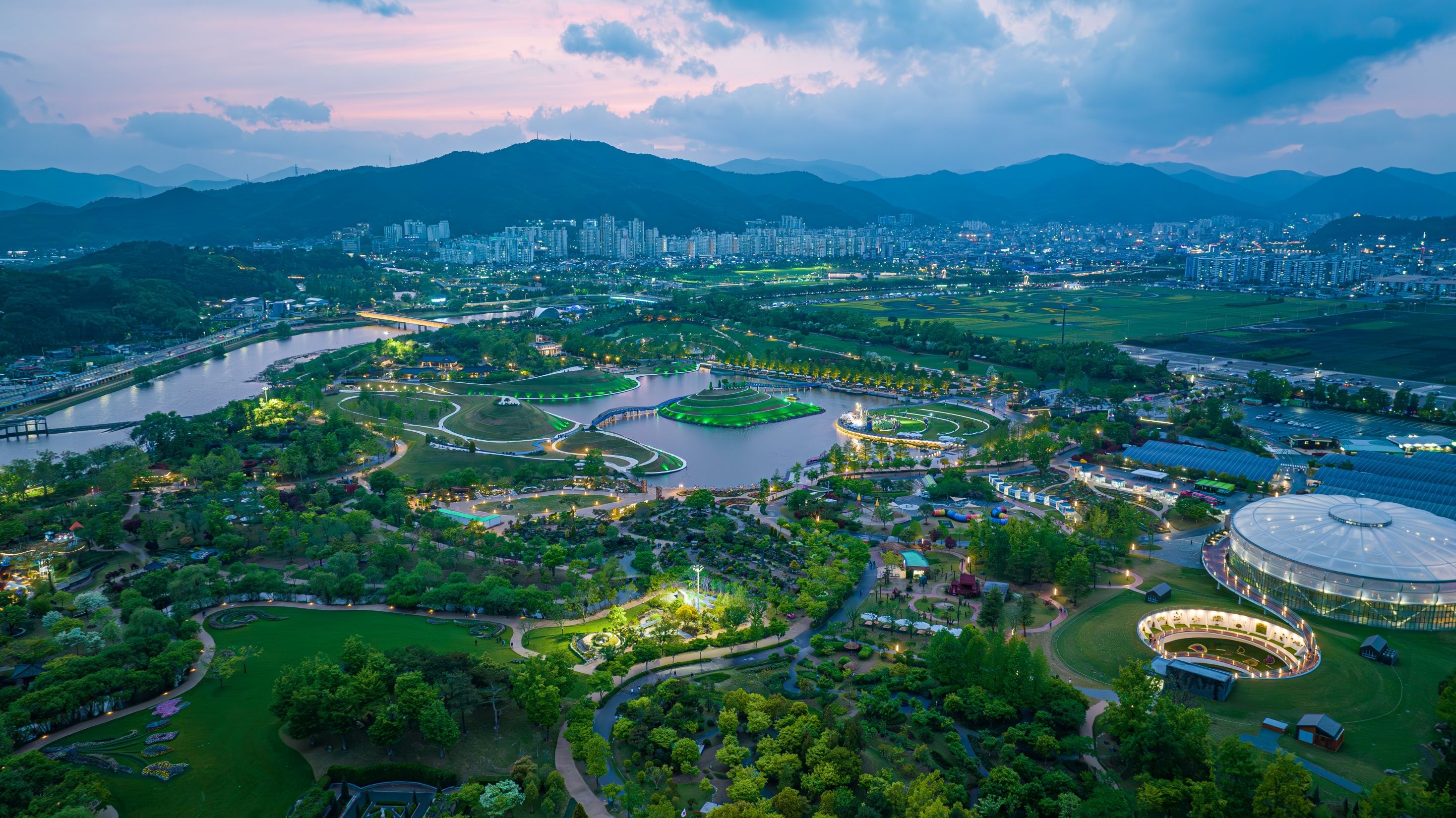
Suncheon City established South Korea’s first ecosystem-driven urban plan to permanently preserve Suncheonman Bay. By restructuring urban areas into “Preservation,” “Buffer,” “Transition,” and “Urban” zones, Suncheon transformed the area into an ecological buffer between wetland and city. Later, a detention pond and four-lane road—both gray infrastructures—became the eco-friendly shared spaces of Ocheon Green Square and Green Island, extending the ecological axis downtown.The 2013 and 2023 International Garden Expos proved the initiative’s public and economic value; the 2023 Expo attracted 9.81 million visitors, generating economic ripples. This success prompted the national government to elevate the Dongcheon Stream to National River status and provide financial support. Today, Suncheon’s enhanced environment attracts cultural and future-industry firms, demonstrating that ecological conservation can simultaneously drive biodiversity, regional resilience, and development while addressing local depopulation.
In the 1990s, Suncheon faced the critical challenge of permanently preserving Suncheonman Bay.Industrialization in neighboring cities led to aggregate extraction and land reclamation, damaging the mudflat and wetland ecosystem. Despite being a vital wintering ground for the endangered hooded crane, the lack of protective infrastructure led to frequent crane fatalities from collisions with utility poles and wires. Since Suncheonman Bay represents the core asset sustaining the city’s identity, its potential loss was viewed as the loss of Suncheon’s future, and this realization sparked a definitive shift toward permanent conservation.However, traditional conservation methods struggled to control urban development, link ecological value to the city, or embody the city’s future vision.To overcome these limits, Suncheon established South Korea’s first ecosystem-driven urban plan. This innovative framework transformed ecological preservation into a foundation for urban spatial restructuring, citizen welfare, and an expanded “ecological economy.”This initiative aligns with SDGs 11, 13, and 15. It secured a robust legislative basis through the designation of South Korea’s first National Garden and the enactment of the “Special Act on the Support for and Post-use of the 2023 Suncheonman International Garden Exposition.”
Suncheon’s innovation stemmed from the realization that urban sprawl toward Suncheonman Bay must be halted and that ecological values must expand into the urban fabric and into the lives of citizens. In 2008, the city established the “Mid-to-Long-term Plan for the Conservation and Sustainable Use of Suncheonman Bay,” initiating its ecosystem-driven urban planning.
The city restructured its geography into four zones: Preservation, Buffer, Transition, and Urban. By creating the Suncheonman National Garden and expo grounds between the urban center and the wetlands, Suncheon designed an ecological buffer to insulate the bay from the pressure of urban development. This framework enabled the successful hosting of the 2013 Suncheonman International Garden Expo—South Korea’s first international garden event—and led to its designation as the nation’s first National Garden. Going the extra mile, Suncheon continued to connect ecological axes through the protection and restoration of the Dongcheon Estuary. For the 2023 Expo, this axis reached the city center through the creation of Ocheon Green Square and Green Island.This strategy served as a localized solution, leveraging Suncheonman Bay’s unique geography to transform ecological conservation into urban spatial restructuring and to improve the quality of life for all residents.
Suncheon’s ecological urban planning has generated measurable transformations across ecological, spatial, and economic domains.Ecologically, the hooded crane population skyrocketed from 167 in 2006 to 8,600 in 2026, establishing Suncheonman Bay as the premier wintering ground. International recognitions—including designations as Ramsar Wetland City, Biosphere Reserve, and UNESCO World Natural Heritage—validate these breakthroughs.In the spatial domain, the Suncheonman National Garden serves as a vital buffer zone. The 2023 development of Ocheon Green Square and Green Island extended the ecological axis into the city center, fostering citizen accessibility to nature.These changes have catalyzed broad community impacts. The 2023 International Garden Expo drew 9.81 million visitors, generated USD 1.51 billion in production, and employed 25,149 people. In 2025, a portion of the garden’s profits was redistributed to citizens as subsidy.Furthermore, the improved living environment has attracted major industries such as animation industry leader LOCUS and aerospace giant Hanwha Aerospace to Suncheon, expanding the city’s future industry with its eco-friendly infrastructure as its backbone.These outcomes, managed through official monitoring and administrative statistics, directly contribute to SDGs 8, 11, 13, and 15, proving that ecological preservation can serve as a powerful engine for future-oriented urban industry.