Amman, Jordan
From Grey to Green: Integrating Greywater Reuse, Urban Agriculture and Community Engagement in Amman’s Parks
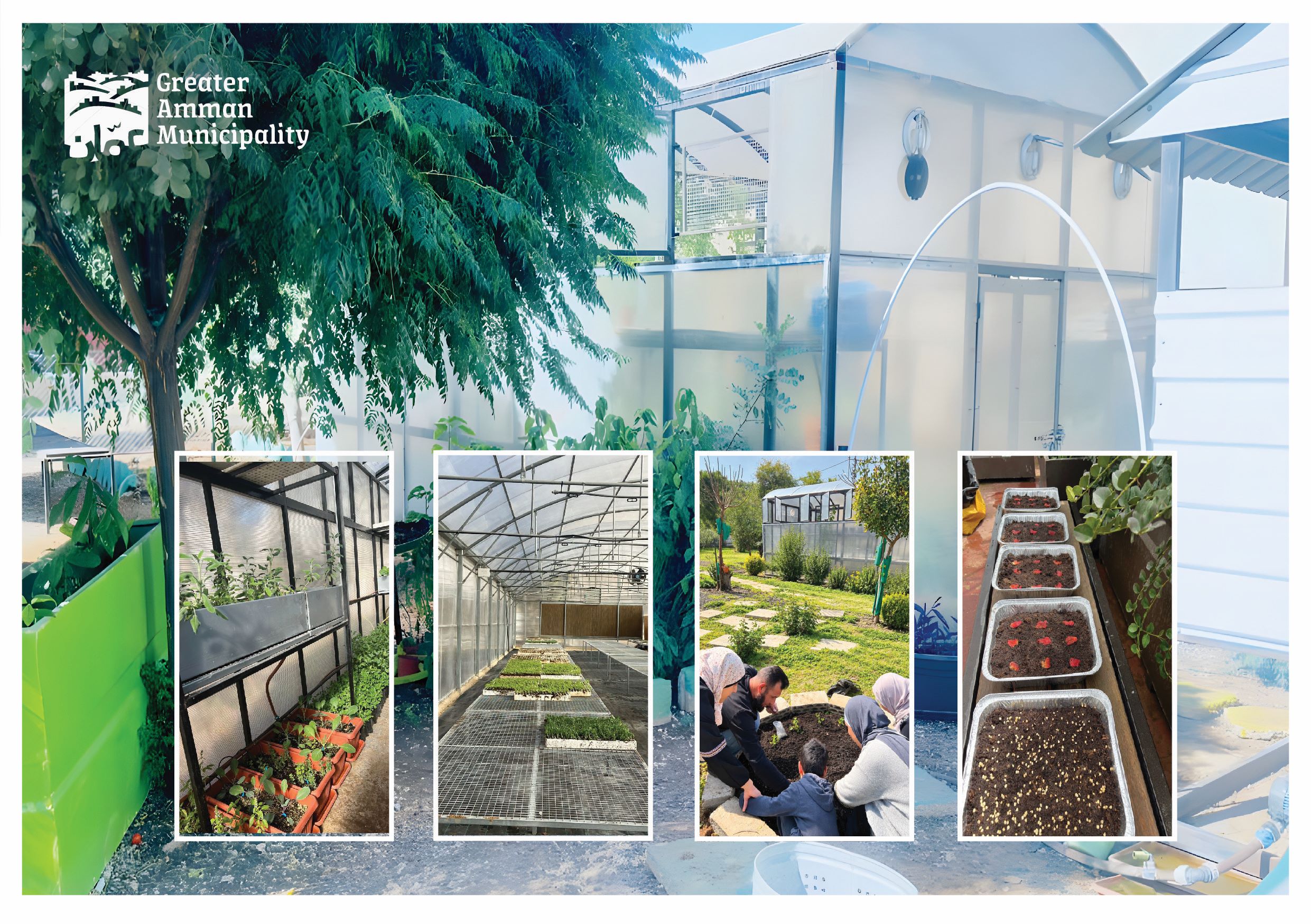
Under the Greater Amman Municipality vision, a citywide initiative transformed five community parks—one in each administrative region of Amman—into multifunctional green spaces integrating urban agriculture, circular water management, and community engagement. The initiative rehabilitated Prince Hashem Bird Garden (Al-Abdali), Al-Wihda Garden (Wadi Al-Seer), Sareyat Alalam Garden (Basmaan), Al-Jubaiha Traffic Garden, and Al-Jweideh Traffic Garden. The parks incorporate greenhouses, outdoor planting beds, and fruit trees supporting seasonal food production while improving urban biodiversity. Treated greywater is reused through drip irrigation systems, reducing freshwater consumption by about 50% annually in a water-scarce environment. Workshops and hands-on participation engaged over 3000 community members, students, and volunteers, strengthening environmental awareness and promoting sustainable practices like urban gardening and water conservation. The initiative demonstrates a cost-effective, scalable, and replicable model for climate-resilient urban green spaces in Amman, addressing water scarcity challenges effectively and enabling institutional learning and long-term sustainable management across municipal operations and expansions.
Amman’s rapid urbanization has reduced residents’ connection to nature and limited access to meaningful green spaces, while water scarcity continues to challenge park management and urban agriculture. Traditional greening efforts have focused mainly on ornamental landscaping, offering limited environmental, social, or educational value.This initiative addresses these gaps by transforming five neighborhood parks across Amman into multifunctional green spaces that integrate urban agriculture, fruit trees, greenhouses, and outdoor planting areas. It promotes sustainable practices by reusing treated greywater from park facilities through drip irrigation systems, reducing reliance on freshwater while demonstrating circular water management in a water-scarce context.The initiative also emphasizes community engagement through workshops and hands-on activities involving residents, schools, and volunteers. These efforts enhance environmental awareness, encourage responsible resource use, and strengthen social cohesion.Supported by a strong policy framework, the initiative aligns with key city strategies, including the Greater Amman Municipality Strategy (2022–2026), the Amman Resilience Strategy, the Climate Action Plan, and the Green City Action Plan. It also contributes to global agendas such as SDG 11 and SDG 6, the New Urban Agenda, and the Paris Agreement, translating international sustainability commitments into practical, scalable solutions at the city level.
The Greater Amman Municipality (GAM) launched this initiative to address rapid urbanization, limited green space, water scarcity, and weak community connection to nature. The project aims to create multifunctional, sustainable parks combining recreational and productive value, reconnect communities with agriculture, and demonstrate resource-efficient solutions aligned with GAM Strategy 2022–2026, Jordan’s National Sustainable Development Strategy, and SDGs 6 and 11.Key design factors included equitable distribution across Amman’s five regions, integration of urban agriculture through greenhouses and planting beds, selection of fruit trees and seasonal crops suitable for Jordan’s semi-arid climate, and reuse of treated greywater through drip irrigation.
Safety, accessibility, and inclusivity were prioritized to ensure community engagement.The initiative was tailored to the local context by adapting crop selection to climate conditions, maximizing water efficiency, and engaging residents through workshops and hands-on activities. Existing parks were retrofitted, reducing costs and leveraging familiar spaces.Expected outcomes include saving up to 50% of freshwater annually and engaging around 3,000 participants. The project demonstrates a replicable model combining participatory approaches, circular water management, and nature-based solutions for resilient urban development.
The initiative has generated measurable environmental, social, and institutional impacts aligned with SDGs 11, 6, 12, and 13. Five neighborhood parks were rehabilitated into sustainable community spaces covering (≈9 hectares), improving access to green areas for nearly 20% of Amman’s residents. Greywater reuse systems reduced potable water used for irrigation by around 50% annually—from 8 million litres to 4 million litres—while water quality is regularly tested in GAM laboratories to ensure compliance with environmental and public health standards.Initiative promoted behavioral change through engagement with three universities, ten schools, and over 3,000 volunteers ≈9,000 hours/year. Surveys show that 71.2% of participants improved awareness of water conservation and urban agriculture. The rooftop farming initiative was implemented on more than 100 residential rooftops, enabling households to produce part of their food needs. As one participant shared: “Before joining the project, I never imagined I could grow my own food at home. Today, my rooftop garden provides fresh vegetables for my family, and I feel proud to share this knowledge with my neighbors.”Institutionally, the initiative partnered with UNDP Jordan in 2024 to rehabilitate Tafawoq Park, establish a training center. About 500 participants received certified training, with progress monitored through KPIs.