Seoul, Republic of Korea
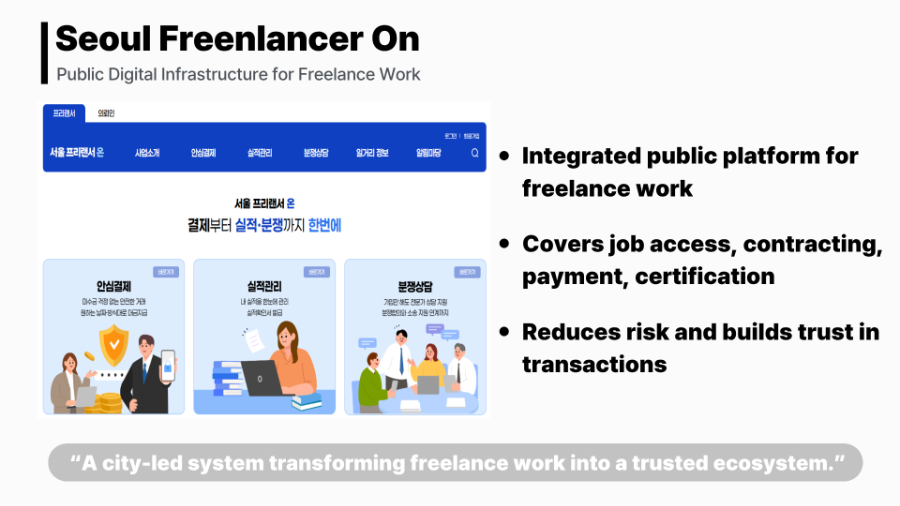
Seoul Freelance On: A Public Platform for Fair and Secure Freelance Work
Seoul is redefining urban labor protection in the digital economy. Seoul Freelance On is a public digital infrastructure designed to correct structural imbalances where freelancers face unpaid wages, weak bargaining power, and high intermediary fees. Moving beyond fragmented support, the city built an integrated system that directly secures the contracting, payment, and verification processes. The platform enables end-to-end digital transactions—from electronic contracting with e-signatures to escrow-based payments—within a single system. It also converts transaction data into verified work records, allowing freelancers to build portfolios and issue certified performance documents for employment or financial purposes. By reducing risk, increasing trust and formalizing freelance activities, the platform has rapidly expanded since its launch in 2025 and upgrade in 2026. Seoul Freelance On offers a scalable model for cities addressing the future of work.
Freelance work is growing fast—but protection is not. In Seoul, the expansion of the digital economy has increased the number of freelancers, but most remain exposed to unpaid work, unfair contracts and weak legal protection. This is driven by structural imbalances between freelancers and clients. At the same time, private platforms dominate the market while charging high fees, further reducing freelancers’ income. Existing policies have focused on training or information, but failed to address how transactions actually happen. The core problem is clear: a lack of trust, transparency and institutional safeguards in the freelance market. Seoul recognized that this is not a service gap, but a market failure—and requires direct public intervention. Seoul Freelance On was developed to shift the paradigm from "passive information" to "active systemic protection." This initiative builds a transparent and accountable ecosystem by institutionalizing fair transaction standards. It aligns with the UN Sustainable Development Goals (SDGs), specifically Goal 8 (Decent Work and Economic Growth), Goal 10 (Reduced Inequalities) and Goal 12 (Sustainable Consumption and Production) by ensuring that the future of work is both inclusive and sustainable within the framework of Seoul's municipal labor policies.
This innovation was driven by a clear challenge: as the freelance workforce expands in the digital economy, its vulnerability also deepens. In Seoul, freelancers face increasing risks of unpaid work, weak bargaining power and lack of verifiable work records. The city recognized that these challenges are interconnected problems embedded in how freelance transactions are conducted.
During the design phase, the key principle was integration. Instead of addressing each problem separately, Seoul focused on building a seamless system supporting the entire transaction process. This led to a one-stop platform that connects electronic contracting, secure payment and performance certification. Another critical consideration was accessibility and trust. The system was designed to enable fully remote transactions through electronic contracts with e-signatures and escrow-based payments, reducing uncertainty for both freelancers and clients. The solution is uniquely tailored to Seoul’s status as a hyper-digitalized global hub where remote work is the standard. By enabling end-to-end digital processes, the platform mirrors the agile working patterns of the city’s modern labor market. It transforms transaction history into social capital, fostering a trusted business environment that transcends physical boundaries. Through this approach, the initiative delivers a locally grounded yet globally relevant model for managing freelance work.
Seoul Freelance On has catalyzed a systemic shift toward SDG 8 (Decent Work) and SDG 10 (Reduced Inequality) by institutionalizing fairness in the gig economy. In 2025, the platform recorded 1,200 users and KRW 113 million in transactions. After its 2026 upgrade, it surpassed this volume within just two months, reaching KRW 121 million and 866 new users. This growth signifies a fundamental behavioral shift: by eliminating payment risks through escrow systems, the platform has established a new normative standard where trust is built on institutional safeguards rather than informal verbal agreements. High satisfaction (88%) and reuse intent (86%) provide clear evidence that providing digital security directly enhances professional focus and service quality for freelancers. The Seoul Metropolitan Government (SMG) monitors these shifts through real-time transaction logs and regular satisfaction surveys.