Kuala Lumpur, Malaysia
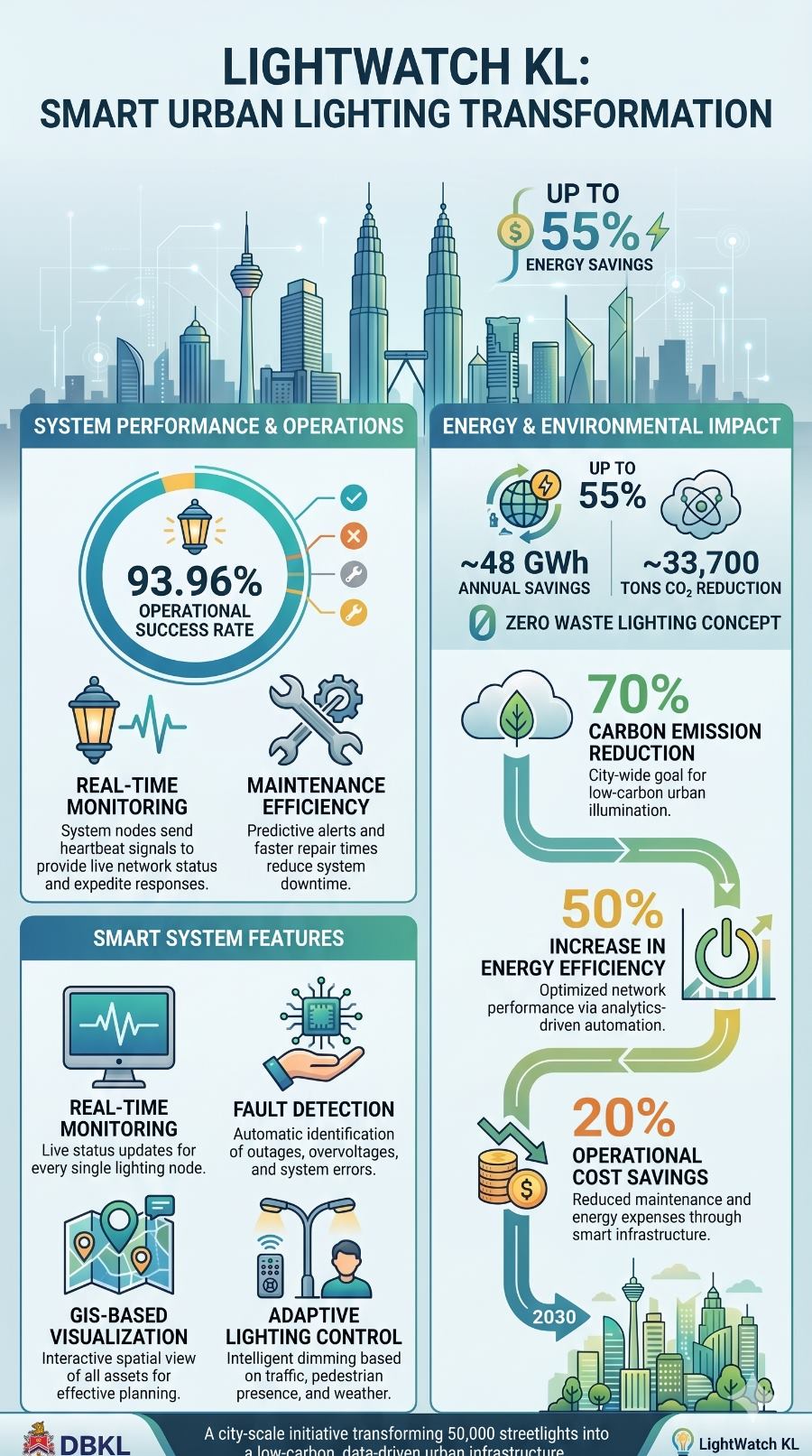
LightWatch KL: Transforming Urban Lighting into a Low-Carbon, Data-Driven City Infrastructure
LightWatch KL, launched in 2018, is a city-scale smart lighting initiative transforming Kuala Lumpur’s public lighting into a low-carbon, data-driven urban infrastructure. Integrating high-efficiency LED upgrades with a centralized digital monitoring platform, it enables real-time energy tracking, fault detection, and performance analytics across thousands of streetlights. The initiative addresses light waste—excessive and inefficient illumination—through optimized, demand-based control aligned with a “zero waste lighting” approach.It delivers significant reductions in energy use and carbon emissions while improving maintenance response times and lighting reliability. Enhanced and better-directed illumination minimizes dark spots and light spill, contributing to safer public spaces and improved urban livability.LightWatch KL also strengthens governance through transparent data, predictive maintenance, and optimized resource allocation, while serving as a scalable and replicable model for sustainable urban transformation, achieving up to 55% energy savings and reducing approximately 33,700 tons of CO₂ annually.
Kuala Lumpur faced increasing challenges in managing a large-scale conventional street lighting network characterised by high energy consumption, rising maintenance costs, and limited real-time visibility of asset performance. Inefficient lighting design also contributed to light waste—excessive, misdirected, or unnecessary illumination—resulting in energy loss, light pollution, and environmental impacts. Frequent lighting failures and delayed response times further affected public safety and urban livability. Previous approaches relied on manual inspections and reactive maintenance, lacking data integration and system-wide coordination.LightWatch KL was developed to address these challenges by transforming street lighting into a centralized, data-driven urban infrastructure. The initiative advances a “zero waste lighting” approach by optimizing lighting levels, reducing unnecessary energy use, and enabling precise, demand-based illumination. It aims to enhance efficiency, improve service reliability, and strengthen governance through real-time monitoring, predictive maintenance, and optimized resource allocation—redefining light as a managed urban resource rather than wasted output.The initiative is supported by municipal commitments to energy efficiency and smart city development, aligned with Malaysia’s low-carbon agenda. It contributes directly to global frameworks including SDG 11 and SDG 13, the New Urban Agenda, and the Paris Agreement by reducing emissions, minimizing light waste, and promoting sustainable urban systems.
LightWatch KL was driven by the need to modernize Kuala Lumpur’s ageing street lighting system into a more efficient, responsive, and sustainable urban infrastructure. Rapid urban growth, increasing energy costs, and rising public expectations for safer streets highlighted the limitations of conventional, maintenance-heavy approaches.During the design phase, key considerations included energy efficiency, operational reliability, real-time visibility of assets, and the reduction of light waste—ensuring that lighting is precisely delivered where and when needed.
The solution integrates high-efficiency LED technology with a centralized digital monitoring platform, enabling data-driven control, faster fault response, and optimized maintenance planning. A “zero waste lighting” principle guided the system design, minimizing unnecessary illumination and reducing environmental impact.The strategy was tailored to Kuala Lumpur’s dense urban environment, diverse road networks, and high public usage patterns, ensuring adaptability across commercial, residential, and high-traffic areas. The modular and scalable design also allows phased implementation and future integration with smart city systems, positioning LightWatch KL as a practical and replicable model for cities transitioning towards low-carbon and intelligent urban infrastructure.
LightWatch KL has generated measurable outcomes aligned with global sustainability and urban development agendas. The initiative contributes directly to SDG 11 (Sustainable Cities and Communities) and SDG 13 (Climate Action) through improved urban safety, energy efficiency, and reduced environmental impact.Evidence of change includes up to 55% reduction in energy consumption, equivalent to approximately 48 GWh annually, and an estimated 33,700 tons of CO₂ emissions reduction per year. Operational data from the LightWatch KL platform shows improved system reliability, with over 90% of streetlights consistently operational, alongside faster response times through real-time fault detection and predictive maintenance.Behavioral and institutional shifts are evident in the transition from reactive maintenance to data-driven and performance-based operations, supported by centralized monitoring and analytics. The system has also improved service accessibility, enabling quicker interventions and better coverage across urban areas.Progress is continuously measured using real-time data collected through the LightWatch KL platform, including energy consumption, asset status, and maintenance performance. Monitoring and evaluation are conducted by DBKL, supported by contractors and system providers, ensuring transparency, accountability, and continuous improvement in service delivery.