Foshan, China
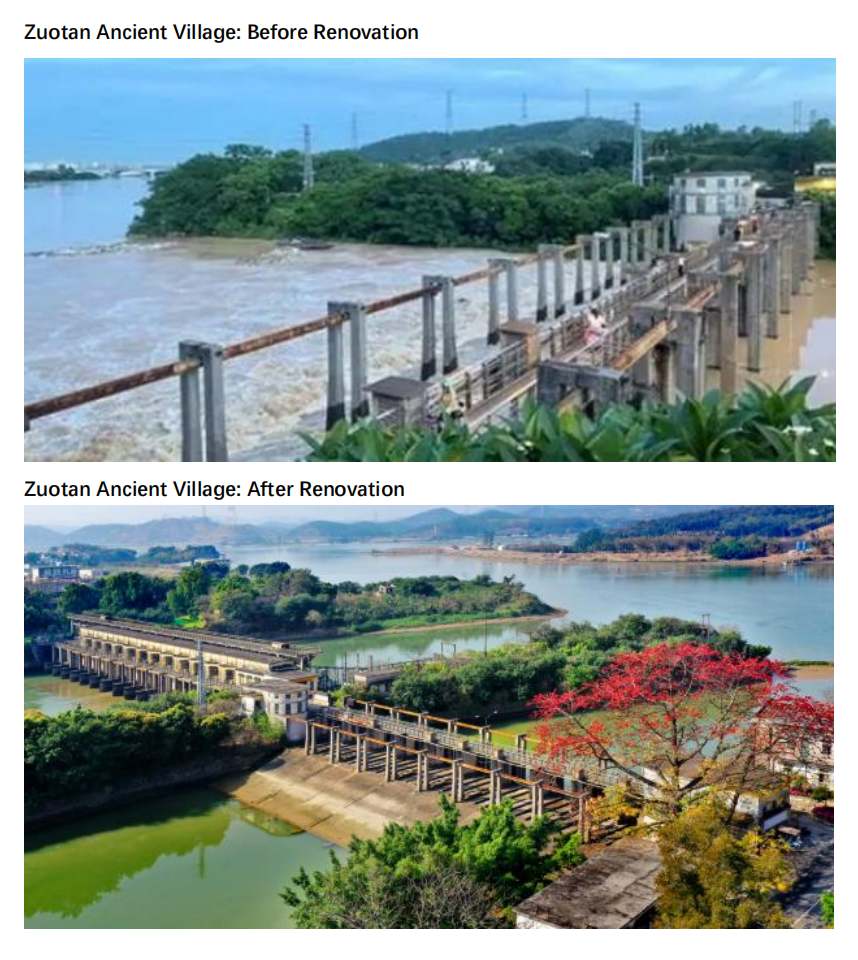
Sangyuanwei: Reviving a Millennium of Human-Water Symbiosis in Foshan
For a thousand years, the Sangyuanwei dike system protected Foshan's people and fields. Then industry arrived. Waterways were hardened. Mulberry ponds shrank by half. The ancient rhythm of "human-water symbiosis" was dying.This project set out to listen to what the water was saying.Starting in 2010, a coalition of planners, ecologists, and local communities began the slow work of restoration—not by imposing modern engineering, but by reviving ancient wisdom. The result is China's first "urban-water coupling" technical standard, now guiding development across the nation.Today, 33 hectares of mulberry-dike fish ponds have been restored. Egret populations are returning. And in just six months, over 8 million visitors have come to walk the dikes, learn from the wetlands, and rediscover what a living heritage site can be.Sangyuanwei is a proof of concept: that ecology, culture, and economy can thrive together. And its lessons are ready to travel.
For centuries, the Sangyuanwei dike system was a marvel of human ingenuity—a 100-mile network of embankments, sluices, and mulberry-dike fish ponds that sustained generations. It was not just infrastructure. It was a philosophy: "water and people rise together".Then came the 1980s. Factories replaced fish ponds. Concrete replaced soft banks. The ancient system fragmented into isolated pieces. By 2010, over 50% of the mulberry-dike ponds had disappeared. Water birds left. Young people followed.Previous restoration efforts failed because they treated symptoms, not causes. One department built a flood wall. Another promoted tourism. A third protected heritage. But no one asked: What does the water need to thrive again?The result was a landscape of missed connections—beautiful old dikes leading to polluted canals, heritage sites surrounded by empty villages.This project began with a different question: "What if we stopped fighting the water and started learning from it again? What if we could restore not just ponds, but livelihoods? Not just dikes, but dignity?"The challenge was immense: 265 square kilometers, 40 years of neglect, and a tangle of jurisdictional boundaries. But the opportunity was greater: to create a global model for urban-water symbiosis that works for people, planet, and prosperity.
The innovation began with a radical act of humility: “we stopped designing for water and started designing with water.”From this shift came the "Five-Water" strategy—a framework that sounds technical but is deeply human.
1. Define the city by water. We mapped the original hydrological patterns—where water wanted to flow, where it had been blocked. Ancient wisdom became modern data.
2. Shape the city with ecological metrics. Instead of arbitrary development targets, we asked: “How much water surface does this landscape need to breathe?” The answer became law.
3. Integrate stakeholder needs into a blue-green network. Farmers, fishers, developers, tourists—all had a seat at the table. Their competing demands became design constraints.
4. Nourish the city through green corridors. A 100-mile network of restored wetlands and tree-lined paths now connects previously isolated communities.
5. Revitalize the city by linking agriculture to the cultural economy. Sericulture heritage became festival IP. Fish ponds became classrooms. Tradition became a business model.The result is China's first "urban-water coupling" technical standard—not a rigid code, but a living framework that has already been adopted in Xiong'an and Nansha. It proves that the best technology for the future is sometimes a thousand years old.
1. Key Achievements
•Ecology: Established a 33-hectares restoration zone, reviving the traditional mulberry-dike fish pond pattern. Upgrades to "Egret Paradise" and micro-wetlands have significantly improved biodiversity and halted ecological degradation.
•Industry: Integrated cultural IPs (e.g., Land Art Festival), attracting over 8 million visits in six months. With 78 new business entities and the nation's largest freshwater fry center, the project successfully converts ecological value into economic growth.
2. Alignment with UN SDGsThe project precisely targets four goals:
•SDG 8 (Economic Growth): Creates jobs and fosters inclusive growth through a "Production-Living-Ecology" fusion.
•SDG 9 (Resilient Infrastructure): Enhances flood defense via ancient dike reinforcement and smart sluice-pump scheduling.
•SDG 11 (Sustainable Cities): Activates heritage assets, including 1 World Heritage site, 1 5A spot, and 257 ancient trees, integrating conservation with community development.
•SDG 15 (Life on Land): Protects inland water ecosystems and halts biodiversity loss through wetland restoration.
3. Social ImpactVillagers actively participate in co-governance, strengthening community cohesion and providing a verifiable local model for sustainable wetland heritage development.