Guangzhou, China
Guangzhou Enning Road Yongqing Fang Renovation and Revitalization Demonstration Project
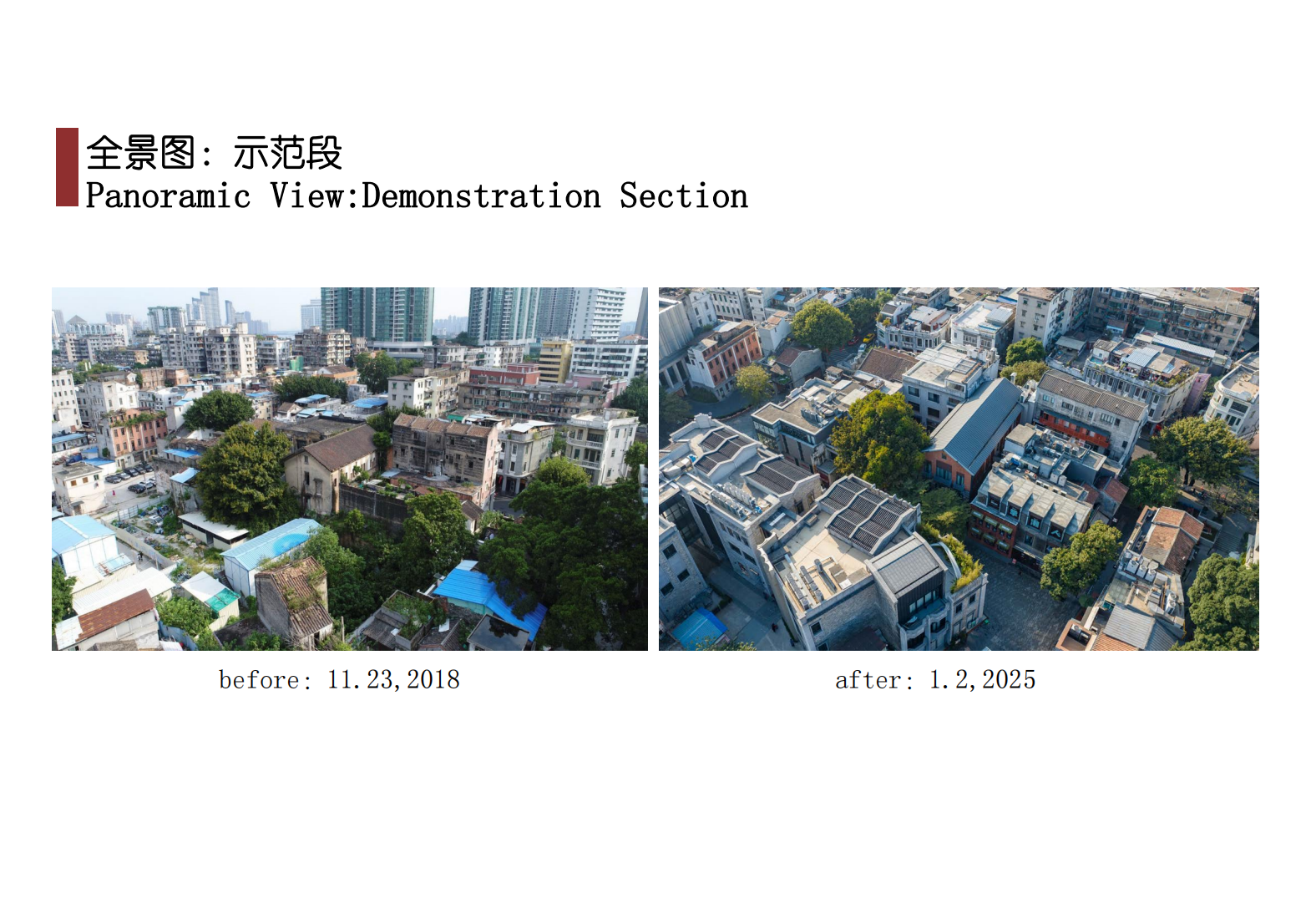
Initiated in 2016, Guangzhou Enning Road Yongqing Fang Renovation and Revitalization Demonstration Project (the Project) involves a land area of 92,000 square meters and a total investment of CNY 1.214 billion. Exploring new approaches to urban renewal and historic city revitalization, the Project marks multiple “firsts” in Guangzhou: the first historic urban renewal project adopting a “reduction planning” approach; the first to align property lines with historic protection boundaries to balance conservation and development; the first to establish a public participation platform, the “Co-creation Committee”; and the first to introduce market mechanisms and private sector participation via a BOT (Build-Operate-Transfer) model. Since its completion in 2025, the Project has radically transformed the neighborhood. With enhanced human habitat, it has drawn young entrepreneurs and residents back to the historic quarter while attracting massive tourist arrivals. Now a cultural calling card, it has rejuvenated a once-dilapidated community.
The Project focuses on addressing the challenges faced by declining historic urban districts, tackling interconnected pain points such as intertwined interest of stakeholders, waterway pollution, alley waterlogging, combined sewer system issues, ecological degradation, physical dilapidation, neighborhood hollowing-out, and local industrial decline. The previous urban redevelopment model relied heavily on incremental expansion and large-scale demolition, which was ill-suited to sustainable urban development. They not only caused irreversible cultural fragmentation and triggered social conflicts, but also led to a “cookie-cutter” homogeneity in urban appearance. They also failed to balance heritage conservation with livelihood improvement, lacking the capacity to generate self-sustaining economic vitality.Deeply aligning with the New Urban Agenda across social, economic, environmental, and spatial dimensions, the Project aims to foster social cohesion and diversity, create jobs, and improve livelihoods. It targets at paving a safe, resilient, and sustainable path for urban development, achieving living conservation and revitalization of historic districts that “preserves residents, physical forms, and cultural spirit”.
To address the decline of historic district, the Project abandons the previous “large-scale demolition and construction” model. Instead, it carefully balances heritage conservation, livelihood improvement, and interests of diverse stakeholders, exploring a sustainable, organic path for urban renewal.
Key principles include safeguarding cultural contexts, improving living environments, coordinating ecological restoration, and balancing economic sustainability with community co-governance.Through a BOT mechanism, the Project engaged enterprises for construction and operation, separating ownership from operational rights. This diversifies conservation funding sources, generating stable long-term income while reducing dependence on one-off land sales and effectively easing government fiscal pressure. The Project also established the city’s first Historic District Co-creation Committee—comprising government, residents, experts, business owners, and media—to facilitate a multi-stakeholder consultation mechanism. Starting from historic preservation, the Project employed an “embroidery-like” micro-transformation approach, innovating site-specific designs tailored to Lingnan’s climate and complex ownership situations to realize living conservation and local symbiosis.
Guided by the dynamic conservation principle of “preserving residents, physical forms, and cultural spirit,” the Project preserved the original demographic makeup, creating a thriving ecosystem where new commercial entities and local residents coexist and prosper. .Materially, it improved living conditions for vulnerable groups and provided business spaces. Spiritually, through the Co-creation Committee and the Whole-Process People’s Democracy Practice Pavilion, it built platforms for resident deliberation, cultural inheritance, and community services , establishing a multi-stakeholder participation mechanism for consensus-building.Following project completion, the local environment, tax revenues, and employment situation have all seen remarkable improvement. Monthly visitor numbers have stabilized at over 200,000, with annual visits exceeding 20 million. This has led to the creation of 1,300 new direct jobs and generated indirect economic benefits of 40-70 billion yuan. The micro-transformation of Yongqing Fang optimizes and repurposes existing land and buildings within the historic district, effectively aligning cultural heritage preservation with livelihood enhancement and economic development. It thus serves as an exemplary model for sustainable urban renewal.