Tulungagung Regency, Indonesia
Safe Community: EB SOLIH Emergency Button and LASKAR Integrated Cardiac Services
This document presents EB SOLIH (Emergency Button Solution In My Hand), representing the third component of the three-part Safe Community framework.
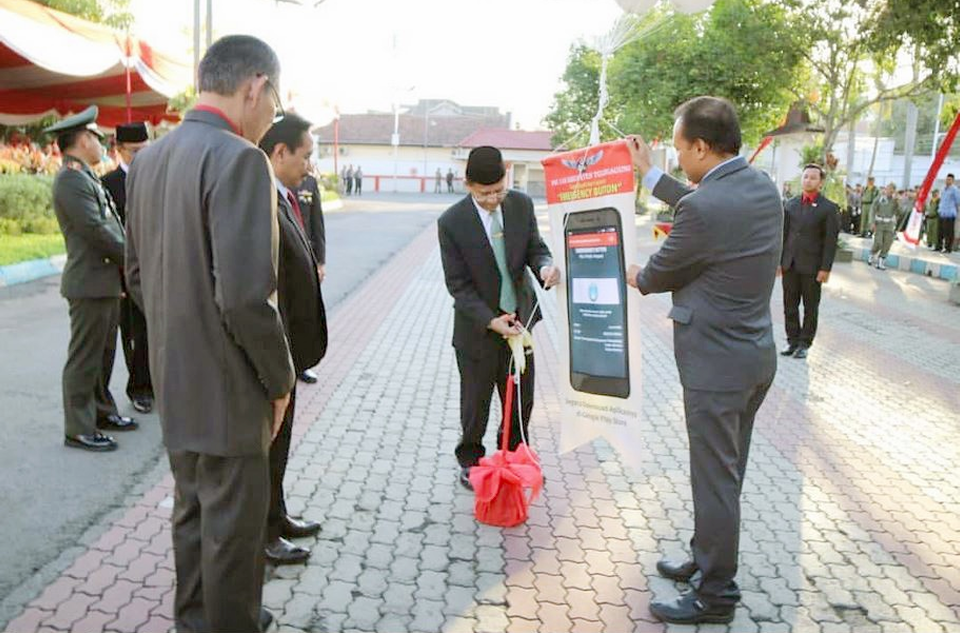
EB SOLIH is a mobile-based emergency response system designed to solve critical delays in medical and non-medical emergency services in Tulungagung Regency. Before its implementation, the Public Safety Centre (PSC) 119 struggled with inaccurate location reporting and the public's inability to remember emergency contact numbers.The innovation utilizes Industry 4.0 technology through a GPS-integrated Android application. By pressing a single button, a user's precise coordinates are automatically transmitted to the PSC 119 command center, allowing for immediate deployment of a Pre-Hospital Care team.
Since its launch, average response times have been halved from 20 to 10 minutes, and public satisfaction has significantly improved. The system fosters a Safe Community by integrating health, police, and disaster management into a unified digital safety net.
Previous approaches, including traditional call centers and earlier hospital-based innovations, were limited by callers' inability to provide accurate location data—especially those from outside the region—and a general difficulty in remembering specific emergency contact numbers during a crisis.
EB SOLIH aims to eliminate these barriers by utilizing a GPS-integrated mobile application that provides instantaneous, accurate coordinates to dispatchers.
This ensures Pre-Hospital Care teams arrive within the golden period, significantly reducing mortality and disability rates while fostering a Safe Community.
The motivation stemmed from critical gaps in the existing Public Safety Centre (PSC) model, where dispatchers struggled with inaccurate location reporting and callers—particularly those unfamiliar with Tulungagung—found it difficult to describe their surroundings or remember emergency numbers. These delays directly compromised the golden period of care, increasing risks of mortality and disability.During the design phase, key factors centered on Industry 4.0 integration to provide a one-grip digital safety net. The planning prioritized GPS-based precision to remove human error from dispatching and a user-friendly Android interface for immediate accessibility.The solution was tailored to the local context by utilizing Single Data verification through National ID (KTP) registration, ensuring accountability and context for responders. Developing the technology in-house allowed for specific adaptations to the regency's geographical needs. Furthermore, the strategy was anchored in local law through PERDA No. 6 of 2018, which mandated seamless coordination between the hospital, police, and disaster management agencies to create a culturally and legally supported Safe Community framework.
The initiative employs a collaborative and networked governance structure, centered around the PSC 119 Command Center at RSUD dr. Iskak. This multi-sectoral network integrates health, safety, and disaster management agencies into a single response ecosystem.
EB SOLIH was developed in-house by the internal IT team of RSUD dr. Iskak using Industry 4.0 technology. This Android-based application supported implementation by automating location tracking; precise GPS coordinates are transmitted directly to the PSC 119 command center, effectively eliminating the verbal communication barriers that previously delayed emergency aid.
Primary indicators tracked between 2017 and 2020 show a 50% improvement in emergency response efficiency, with average arrival times decreasing from 20 minutes to 10 minutes. This shift is accompanied by a dramatic increase in service utilization; emergency calls handled via the PSC 119 system rose from 1,415 to 3,166 annually.The impact is further evidenced by a rise in public satisfaction scores from 82.66 to 85.12 and the formalization of service delivery through Regional Regulation (PERDA) No. 6 of 2018. Progress is systematically measured using real-time digital logs and periodic satisfaction surveys conducted by the internal evaluation team at RSUD dr. Iskak and external community stakeholders. These metrics demonstrate a clear behavioral shift toward digital emergency access and a policy-driven commitment to health equity.
This document presents LASKAR (Layanan Syndroma Akut Terintegrasi), representing the second component of the three-part Safe Community framework. LASKAR (Layanan Syndroma Koronaria Akut Terintegrasi) is an innovative healthcare system in Tulungagung, Indonesia, designed to address high mortality rates from heart attacks. It integrates pre-hospital emergency services (PSC 119), modern emergency department management (INSTAGRAM), and specialized cardiac interventions like primary PCI. By creating a seamless network between the community, ambulance services, and the hospital, LASKAR has drastically improved response times from an average of 250 minutes to just 50 minutes. This integration has resulted in a 50% reduction in Dead on Arrival (DOA) cases and a significant increase in life-saving cardiac procedures. The initiative serves as a national role model, demonstrating how local governance and technological integration can save lives during cardiac emergencies.
Tulungagung faced critical cardiac mortality rates, largely due to fragmented emergency response and low public awareness. In 2015, response times for heart attacks averaged 250 minutes, resulting in a high volume of patients being Dead on Arrival (DOA). Previous approaches were limited by a lack of coordination between community health centers (Puskesmas), emergency dispatch, and specialized hospital units, leaving a tip of the iceberg scenario where many cases went untreated. LASKAR aims to eliminate these gaps through a seamless, technology-driven emergency network. This integrated model has successfully reduced DOA rates by 50%, transforming urban emergency management into a proactive, life-saving system.
The motivation was driven by the quote, “Time is Muscle, Muscle is Life principle.” Local data revealed a significant tip of the iceberg phenomenon: only 88 cardiac cases were treated in 2015 despite an estimated potential of up to 1,734 annual cases. This disparity highlighted high pre-hospital mortality and a critical need for faster, more accessible intervention.
Key design factors centered on transforming fragmented services into a single, integrated continuum. Planning focused on synchronizing the PSC 119 call center with the INSTAGRAM modern emergency department to ensure the specialized cardiac team is activated the moment a case is identified in the field.
The solution was tailored to the local context through a Service Network (Jejaring) connecting 31 community health centers (Puskesmas) and private hospitals. By utilizing tele-EKG technology, medical teams provide rapid remote diagnostics for residents in rural areas. Social equity was further addressed by using hospital (BLUD) and regional (APBD) funds to guarantee care for the poor. This ensures that life-saving treatments, such as Primary PCI, are not limited by a patient’s geography or financial status, making high-tech cardiac care a universal public service.
The LASKAR initiative utilizes a networked and collaborative governance structure that integrates pre-hospital and hospital care. It is clinically led by a specialized Cardiac Team (SKA) from RSUD dr. Iskak, which works in close partnership with the Public Safety Center (PSC 119) and the local Health Office. Collaboration is structured through a formal Service Network (Jejaring) that shares responsibilities across different levels:
- 31 Community Health Centers (Puskesmas) and private hospitals: Responsible for initial diagnostic assessments, stabilization, and immediate tele-EKG transmission to the central hub.
- PSC 119: Serves as the logistical backbone, managing a 24/7 call center for ambulance dispatch and field-to-hospital communication.
- RSUD dr. Iskak: Provides the definitive tertiary care, including 24/7 cardiac catheterization (Primary PCI).
LASKAR utilizes a Digital Emergency System connecting the PSC 119 call center with the hospital’s INSTAGRAM emergency management software. These tools were developed through the integration of existing public safety infrastructure and internal hospital digital transformation. A core technical component is the tele-EKG system, which allows paramedics at 31 community health centers to transmit cardiac data in real-time for immediate specialist diagnosis. This digital integration supported implementation by ensuring the surgical team and Cath Lab were prepared before the patient reached the hospital doors.
The success of the LASKAR initiative is evidenced by a 50% reduction in Dead on Arrival (DOA) cases and a drastic decrease in average cardiac response times from 250 minutes to 50 minutes. Clinical data shows mortality fell from 68 to 32 patients, while morbidity dropped from 676 to 271. Primary PCI procedures increased from zero to 91 annually, reflecting enhanced service access. Behavioral and policy changes include the institutionalization of integrated care via Bupati Decree No. 188.45/80/013/2016 and increased public awareness through massive community education.