Semarang, Indonesia
AISSA (Artificial Intelligence Solusi Sampah) / Artificial Intelligence of Waste Solution
AISSA (Artificial Intelligence Solusi Sampah) is a smart waste monitoring initiative developed by the Government of Semarang City. The system combines artificial intelligence–powered computer vision with a CCTV network installed at 35 Temporary Disposal Sites (TPS) across the city. AISSA automatically detects waste overflow, scattered garbage, and abnormal accumulation around containers in real time. When excessive waste is identified, an automated WhatsApp notification is immediately sent to sanitation staff for prompt response. Integrated with the Pantau Semar monitoring platform and managed by the Department of Environmental Services (DLH) and the Department of Communication, Informatics, Statistics and Encryption (Diskominfo), AISSA transforms conventional manual inspection into digital, data-driven supervision. The initiative improves operational efficiency, accelerates response time, enhances urban cleanliness, and supports evidence-based decision-making. AISSA contributes to sustainable urban governance, climate resilience, and improved public service delivery, and offers a scalable, replicable model for other cities pursuing smart and environmentally responsible transformation.
Semarang City generates approximately 1,000 tons of municipal waste daily, placing increasing pressure on Temporary Disposal Sites (TPS). Traditional waste monitoring relied on fixed collection schedules and complaint-based reporting, resulting in delayed response, overflowing bins, flood risks from clogged drainage, methane emissions, and declining urban livability. AISSA was introduced to transform waste governance from reactive operations to predictive, data-driven public service delivery. By integrating AI-powered computer vision with municipal CCTV networks, AISSA enables real-time detection of waste overflow and scattered garbage, triggering structured escalation and rapid response.
AISSA was motivated by three structural gaps: lack of real-time monitoring, inefficient allocation of sanitation resources, and growing climate-related urban risks. Rather than investing in entirely new infrastructure, the city strategically leveraged existing CCTV assets under the Smart City ecosystem (Pantau Semar). The design prioritized affordability, scalability, and behavioral compatibility with field operations. Key considerations included: Low-bandwidth AI processing suitable for semi-remote TPS, Hourly detection cycles to balance accuracy and resource efficiency, WhatsApp-based alert system to ensure immediate adoption by 219 field officers, Multi-level notification protocol (UPT to Mayor) to reinforce accountability, Dashboard analytics for evidence-based policy planning. Local challenges such as limited electricity and network coverage required adaptive hybrid connectivity solutions and infrastructure upgrades. The system was embedded within existing institutional workflows to avoid resistance and ensure sustainability. AISSA reflects context-sensitive innovation—technologically advanced yet operationally grounded in local realities.
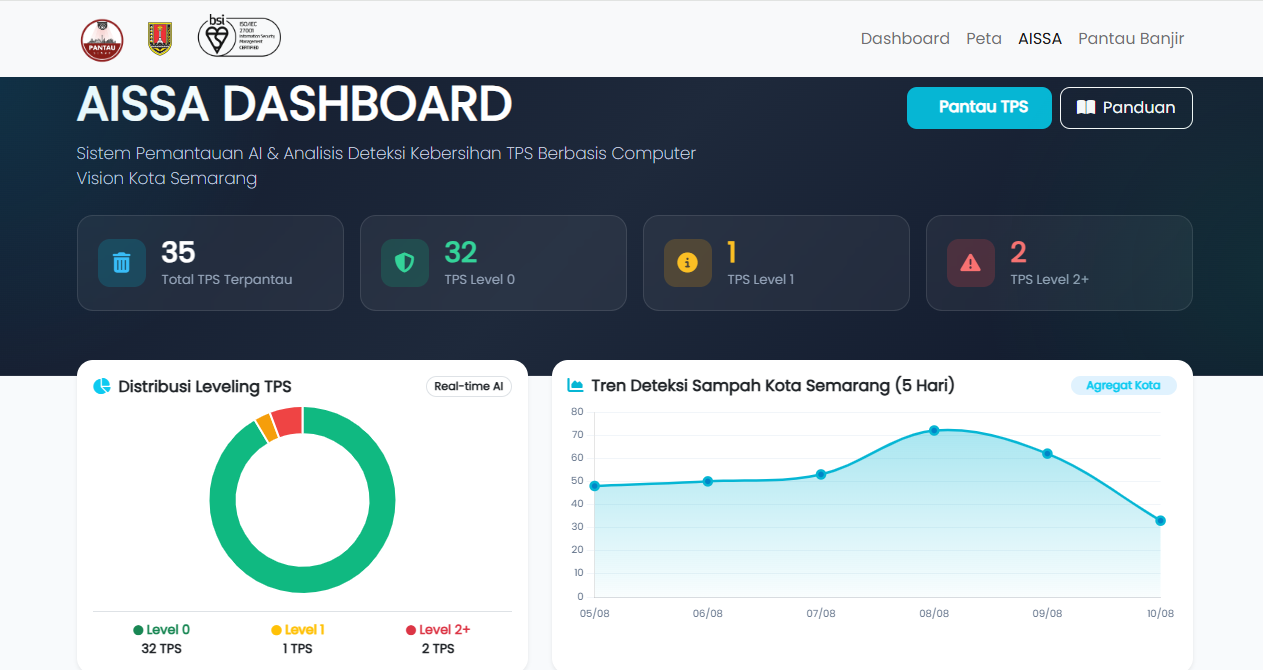
AISSA integrates AI-powered image analytics with the municipal CCTV network to monitor waste conditions at Temporary Disposal Sites (TPS). The system was developed in-house by the Department of Communication, Informatics, (Diskominfo) and implemented operationally by the Department of Environmental Services in Kota Semarang. Key digital tools include AI-based image detection models, the PantauSampah dashboard within the Pantau Semar platform, and automated WhatsApp notifications that alert TPS officers and DLH supervisors based on the severity of waste conditions. The dashboard provides real-time TPS monitoring, data analytics, and cleanliness ranking to support evidence-based decision-making. AISSA reduces reliance on complaint-based monitoring while improving response traceability, transparency, and operational efficiency. Public participation is also supported through the Lapor Semar reporting platform.
AISSA has significantly improved waste monitoring in Semarang by shifting from manual inspections and complaint-based reporting to automated, real-time monitoring using AI and CCTV. The system is currently implemented in 35 TPS, enabling continuous surveillance and faster response through WhatsApp alerts to sanitation officers. Operational data from the PantauSampah dashboard shows measurable improvements, including higher response completion rates, reduced overflow duration at TPS, and decreased reliance on public complaints. These indicators are monitored daily by DLH and used to optimize waste collection routes and prioritize high-risk locations.
At the city level, these improvements contribute to broader environmental performance. In 2025, Semarang received multiple recognitions at the UI GreenMetric World University Rankings 2025, including: 3rd Most Sustainable City in Indonesia, 1st in Governance, 2nd in Energy & Climate Change, and 2nd in Infrastructure & Spatial Planning. These outcomes demonstrate tangible progress toward SDG 11, SDG 12, and SDG 13, particularly in improving urban cleanliness, reducing unmanaged waste, and mitigating flood risks caused by waste accumulation—highlighting AISSA’s role in strengthening data-driven and sustainable city management.