Santiago de Cali, Colombia
“Barrio Obrero”: Urban Regeneration through Salsa as Living Heritage
The initiative proposes an innovative model of urban recovery in “Barrio Obrero” (Obrero Neighborhood), Santiago de Cali, based on activating salsa as a form of living cultural heritage to drive physical, social, cultural, and economic transformation. Through the Heritage Route of the Musical and Dance Complex of Salsa, the project aims to revitalize public space, upgrade urban infrastructure, strengthen community ownership, and stimulate local economies linked to culture, tourism, and collective memory. Beyond a physical intervention, the initiative integrates urban planning, community-based governance, and the safeguarding of intangible cultural heritage to consolidate “Barrio Obrero” as an emblematic cultural district of Cali. This approach transforms cultural identity into a practical tool for sustainable urban development, social inclusion, and economic activation and aligns with the city’s planning instruments and cultural development strategy.
“Barrio Obrero”, the historic cradle of salsa in Santiago de Cali and a key repository of the city’s intangible cultural heritage, is facing urban deterioration, fragmentation of public space, and a gradual loss of community ownership. These dynamics threaten the continuity of its cultural practices and its identity as an emblematic territory. Despite its significance, previous interventions have addressed physical, social, and cultural dimensions in a fragmented manner, limiting their impact and failing to tackle the area’s structural challenges. The initiative seeks to overcome these limitations through an integrated model that combines urban recovery with the safeguarding of living heritage and local economic activation, positioning culture as a structuring axis of territorial development. This approach responds to a global trend in which culturally rich neighborhoods require models that effectively integrate intangible heritage into urban planning processes.
The motivation stems from the progressive loss of identity, community ownership, and intergenerational transmission of cultural practices in “Barrio Obrero”, as well as the need to develop urban intervention models that recognize the functional value of culture in shaping the territory.
The innovation of the initiative lies in transforming the city’s intangible cultural heritage—salsa—into an operational axis of urban planning, moving beyond its traditional treatment as a symbolic or purely cultural element. In response, the project introduces a model that integrates living heritage into the physical design of public space, the structuring of urban routes, and the activation of local economies. During the design phase, key factors were considered, including community participation (encompassing cultural actors, residents, local organizations, and economic sectors linked to salsa) as well as the territory’s social dynamics, everyday uses of space, and existing urban conditions. This approach enabled the solution to be tailored to the local context by recognizing salsa as a living cultural system that connects memory, space, and economy, ensuring that the intervention responds both to community needs and to the cultural vocation of the territory.
The implementation of the project in “Barrio Obrero” has generated tangible impacts at the urban, cultural, and economic levels, demonstrating its capacity to transform the territory through living heritage.
From an urban perspective, the intervention has enabled the recovery of 9,421 m² of public space, incorporating universal accessibility features, street improvements using cobblestone paving, modernization of water and sewage systems, and the undergrounding of electrical networks. These measures have enhanced environmental quality, safety, and service provision.
In addition, modern lighting systems have been installed and landscaping strategies have been implemented to strengthen urban sustainability.
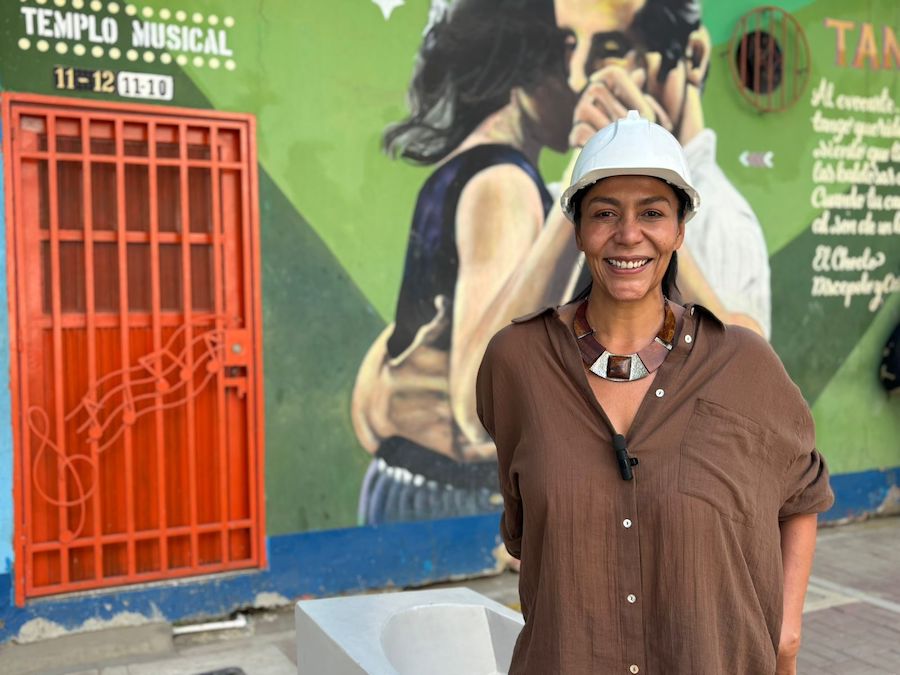
Regarding the cultural component, more than 3,000 m² of murals and 12 sculptures representing iconic salsa figures are currently being developed, consolidating the neighborhood as an open-air museum. The neighborhood’s incorporation into the Cali Fair circuit, one of the city’s main cultural events, has already had an impact on tourism and positioned the area as an emerging cultural destination.
In economic terms, the project is currently generating approximately 150 local jobs and is expected to formalize more than 60 cultural enterprises, as well as to increase the number of visitors by an estimated 67%.