Lanpu (Canton Orchid Garden)
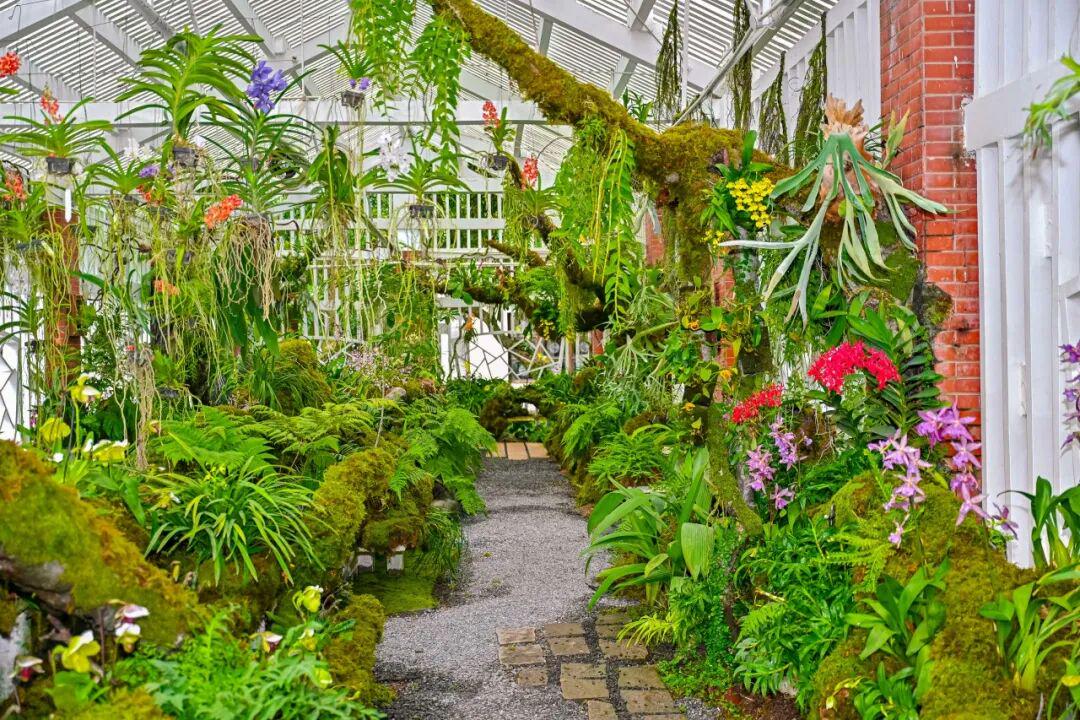
Guangzhou Lanpu (Canton Orchid Garden) is a garden that blends orchid culture with the Lingnan gardening tradition. Covering about 5 hectares, including roughly 9,000 square meters of water, it is laid out around four qualities: tranquility, elegance, charm, and refinement. Within the garden are fish ponds, flower-side pavilions, towers, winding corridors, waterside structures, and rockeries. It is the only garden in Lingnan devoted to the cultivation and appreciation of orchids.
Lanpu has about a hundred of orchid species, along with a wide range of other plants. The site began as a botanical specimen garden in 1951. In 1956 it was redeveloped as a courtyard in the Lingnan style, and in 1957 it became a dedicated orchid-growing garden. In 1960, the veteran revolutionary Zhu De presented his beloved orchid, “Yin Gan Su,” to the Guangzhou Municipal People’s Government; it was later brought to Lanpu for care. In 1962, Tao Zhu, then First Secretary of the CPC Guangdong Provincial Committee, gave the garden its name, Lanpu. Word of the garden spread, and many national leaders and distinguished international guests came to visit. It was opened to the public in 1976, listed among Guangzhou’s first group of historic buildings in 2014, and named one of the city’s first historic gardens in 2023.
Lanpu is divided into an East Section and a West Section. The East Section contains the Banana Gate, the Orchid Exhibition Hall, Tongxin Hall, Luting Pavilion, Zhu De Square, Guoxiang Pavilion, the Thatched Cottage, and Chunguang Pavilion. The West Section includes Fanghua Garden, Jieyun Villa, and Mingjing Pavilion. Built in 1982, Fanghua Garden served as the model for the “China Garden” at the 1983 Munich International Horticultural Exhibition, where it won two of the three gold medals awarded.
Since its founding, Lanpu has the honor of receiving generations of national leaders. It has welcomed figures such as Zhu De, Dong Biwu, Ye Jianying, Xu Xiangqian, Rong Yiren, and Zhang Aiping, as well as guests such as Nixon, Sihanouk, Lee Kuan Yew, and Tung Chee-hwa. Older-generation revolutionaries like Zhu De, Dong Biwu, and Xu Xiangqian, and writers and artists such as Liu Haisu, Qin Esheng, Rong Geng, and Qi Gong, composed inscriptions and poems on the spot during their visits. These treasured works of calligraphy have become an important part of Lanpu’s cultural landscape, deepening its cultural character.